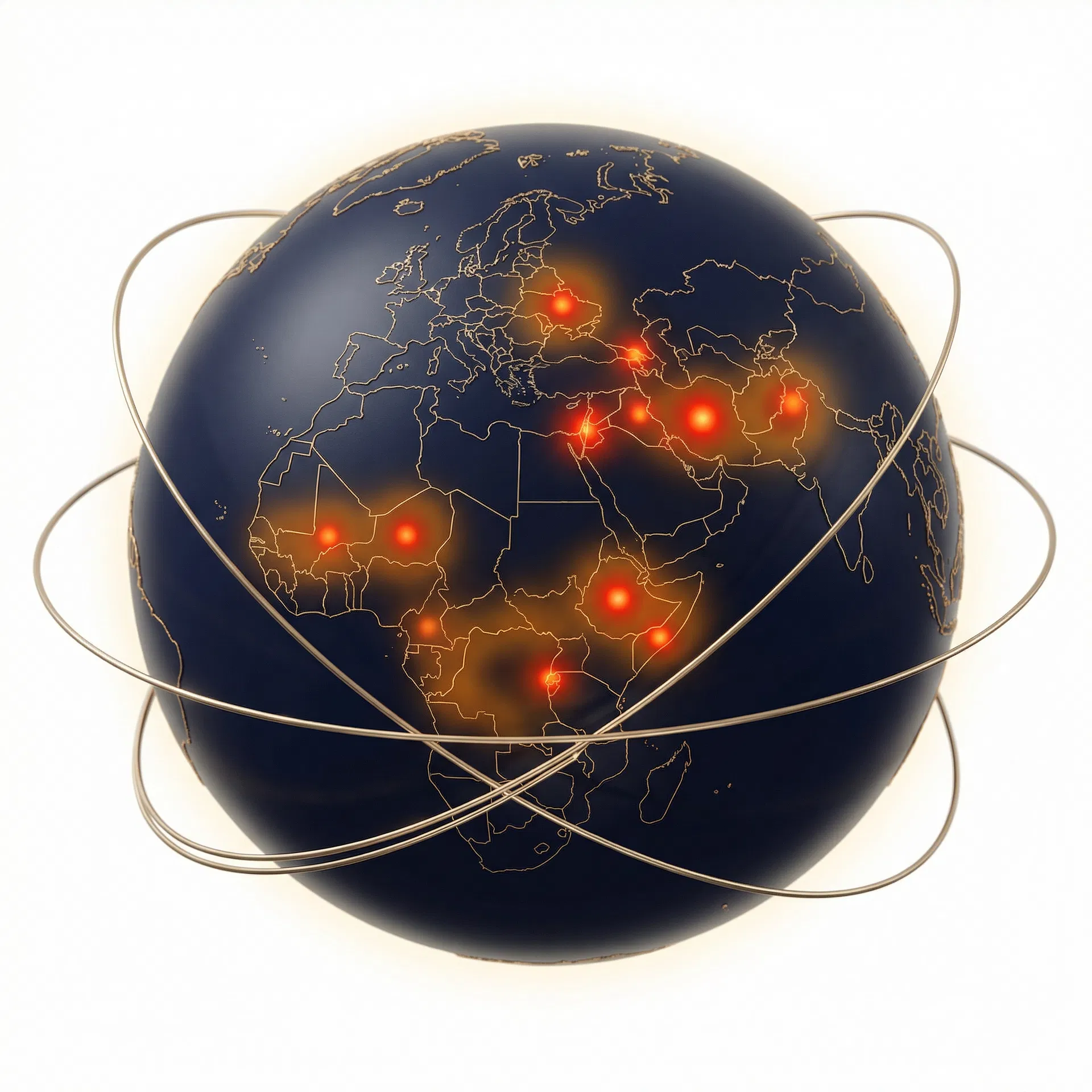
OSINT Intelligence Feed
Real-time categorized OSINT articles from multiple sources (NewsAPI.ai, GDELT, UCDP, ReliefWeb, HDX, ICG CrisisWatch (ACLED pending), and international wire services), processed through the Forge LLM to map each event to ARGOS sub-index dimensions with magnitude and confidence scores. These signals drive the GRS-Live computation across all monitored nations, while GRS-z systemic signals are tracked on the Redshift Monitor.
Total Events
0
Stored, last 30 days
Risk Amplifying
0
Positive magnitude
Risk Reducing
0
Negative magnitude
Avg Magnitude
0.00
Absolute mean
Countries
0
With stored events
Active Signals
0
Countries with active signals
How AI signals have shifted country risk scores over time. Data from scheduled OSINT ingestion batches.
Each event is categorized by the Forge LLM to determine the most affected ARGOS sub-index, impact magnitude (-1.0 to +1.0), and categorization confidence.
Methodology: Events are sourced from multiple OSINT providers including NewsAPI.ai, GDELT, ACLED (Armed Conflict Location & Event Data; pending), UCDP (Uppsala Conflict Data Program), ReliefWeb, HDX, ICG CrisisWatch, and international wire services (Reuters, BBC, Al Jazeera, DW, France24), collectively monitoring news and conflict data across 150+ countries in 65 languages. Each article is categorized by the Forge LLM using structured output to determine: (1) the most affected ARGOS sub-index (ISI, ETI, EVI, CEI, ACI, ENV, or SCI), (2) the impact magnitude on a [-1.0, +1.0] scale, and (3) categorization confidence. These categorizations feed into time-decaying AI signals that adjust the baseline GRS to produce GRS-Live. Signal half-life is 7 days; the scheduler processes high-priority nations (Critical/High GRS) more frequently than lower-risk nations.