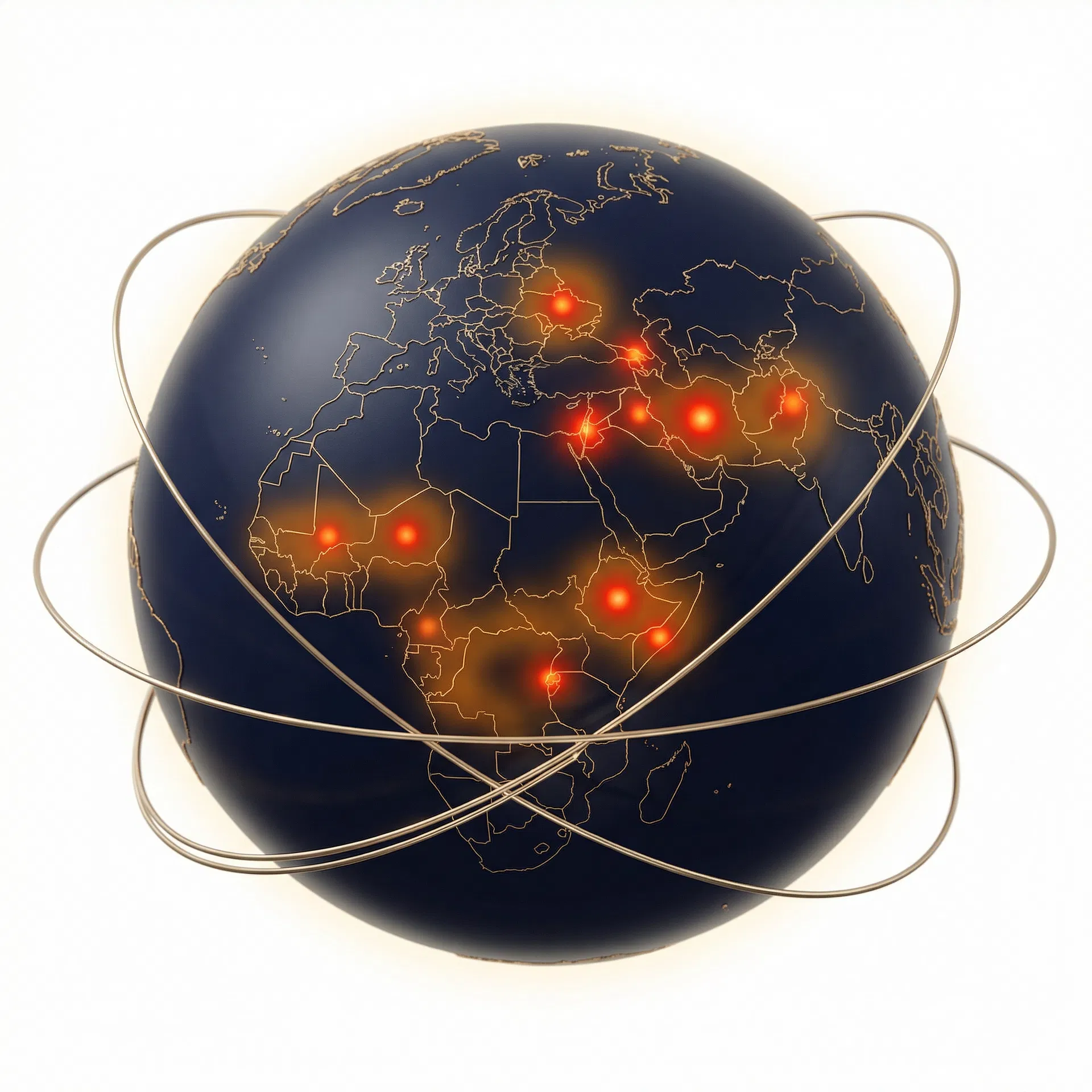
Risk Correlation Matrix
Mapping hidden geopolitical dependencies and contagion pathways. Countries with similar risk profiles, measured across ARGOS sub-indices, reveal structural linkages that amplify shock propagation across borders and blocs.
Positive Correlation
Red cells indicate countries whose risk profiles move in the same direction. A crisis in one is likely to be mirrored in the other - either through direct contagion or shared structural vulnerabilities.
Negative Correlation
Blue cells indicate inverse risk profiles. When one nation's risk rises, the other's tends to fall - often reflecting opposing positions in geopolitical competition or complementary economic structures.
Contagion Pathways
Pairs with correlation ≥ 0.75 are flagged as potential contagion channels. Shared bloc membership (NATO, BRICS+, SCO) amplifies transmission risk, as institutional ties create additional propagation mechanisms.
🇺🇸USA | 🇨🇳CHN | 🇷🇺RUS | 🇬🇧GBR | 🇫🇷FRA | 🇩🇪DEU | 🇯🇵JPN | 🇮🇳IND | GRS | |
|---|---|---|---|---|---|---|---|---|---|
🇺🇸United States | 🇺🇸 | -0.67 | -0.98 | 0.96 | 0.89 | 0.98 | 0.67 | -0.94 | -2.6 |
🇨🇳China | -0.67 | 🇨🇳 | 0.66 | -0.84 | -0.90 | -0.74 | -0.88 | 0.74 | 24.5 |
🇷🇺Russia | -0.98 | 0.66 | 🇷🇺 | -0.96 | -0.90 | -0.98 | -0.72 | 0.93 | 41.9 |
🇬🇧United Kingdom | 0.96 | -0.84 | -0.96 | 🇬🇧 | 0.98 | 0.98 | 0.82 | -0.94 | 1.4 |
🇫🇷France | 0.89 | -0.90 | -0.90 | 0.98 | 🇫🇷 | 0.91 | 0.81 | -0.85 | 3.8 |
🇩🇪Germany | 0.98 | -0.74 | -0.98 | 0.98 | 0.91 | 🇩🇪 | 0.79 | -0.98 | -1.5 |
🇯🇵Japan | 0.67 | -0.88 | -0.72 | 0.82 | 0.81 | 0.79 | 🇯🇵 | -0.83 | 2.7 |
🇮🇳India | -0.94 | 0.74 | 0.93 | -0.94 | -0.85 | -0.98 | -0.83 | 🇮🇳 | 19.2 |
Detected Risk Clusters
Countries within a cluster share correlation coefficients above 0.70, indicating structurally similar risk profiles. A shock to one member is likely to propagate to others.
Contagion Pathways
Bilateral pairs with correlation ≥ 0.75 represent potential contagion pathways - channels through which geopolitical shocks in one nation may propagate to another. Shared bloc membership amplifies this risk.
| Nation A | Correlation | Nation B | Shared Blocs | GRS Delta |
|---|---|---|---|---|
🇺🇸United States-2.6 | 0.983 | 🇩🇪Germany-1.5 | NATOG7G20 | ±1.1 |
🇬🇧United Kingdom1.4 | 0.978 | 🇩🇪Germany-1.5 | NATOG7G20 | ±2.9 |
🇬🇧United Kingdom1.4 | 0.977 | 🇫🇷France3.8 | NATOG7G20 | ±2.4 |
🇺🇸United States-2.6 | 0.958 | 🇬🇧United Kingdom1.4 | NATOFive EyesG7G20 | ±4.0 |
🇷🇺Russia41.9 | 0.929 | 🇮🇳India19.2 | BRICS+SCOG20 | ±22.7 |
🇫🇷France3.8 | 0.911 | 🇩🇪Germany-1.5 | NATOEUG7G20 | ±5.3 |
🇺🇸United States-2.6 | 0.889 | 🇫🇷France3.8 | NATOG7G20 | ±6.4 |
🇬🇧United Kingdom1.4 | 0.816 | 🇯🇵Japan2.7 | G7G20 | ±1.3 |
🇫🇷France3.8 | 0.806 | 🇯🇵Japan2.7 | G7G20 | ±1.1 |
🇩🇪Germany-1.5 | 0.786 | 🇯🇵Japan2.7 | G7G20 | ±4.2 |
Methodology: Correlations are computed using the Pearson coefficient across the 5 ARGOS sub-index dimensions (ISI, ETI, EVI, CEI, ACI). Values are z-score normalized before computation. A correlation of +1.0 indicates identical risk profiles; −1.0 indicates perfectly inverse profiles. Clusters are detected at r ≥ 0.70; contagion pathways at r ≥ 0.75. These are structural correlations based on current-period data, not time-series co-movements.